





An automatic palletizer does not make an unstable load stable simply by stacking it faster or applying more compression. It has to detect why the load is unstable, choose a stacking pattern that avoids amplifying that weakness, place each unit without creating impact, and hand off a pallet that can survive forklift handling and transport. The correct response differs sharply between lightweight crushable cartons, bulging bags, mixed-SKU cases, and loads with an off-center center of gravity.
That distinction matters because instability is rarely caused by one variable. A pallet may lean because cartons vary in height, slide because their outer surfaces are low-friction, deform because the bottom layers cannot support upper-layer weight, or fail because a valid static stack becomes unstable during conveyor acceleration. Automatic palletizing systems address these conditions through a combination of inspection, end-effector control, placement logic, and downstream containment. No single component can compensate for poor load geometry on its own.
Instability begins before the palletizing cell
A palletizer can only work with the product presentation it receives. If cases arrive skewed, bags are partially filled, carton flaps are open, or product dimensions vary outside the approved range, the palletizing cell inherits a problem created upstream. This is why a reliable design begins by separating “difficult to palletize” from “not suitable for automated palletizing in its current condition.”
Common instability sources include:
- Dimensional variation: cartons with inconsistent length, width, or height create gaps and reduce layer-to-layer contact.
- Low compression strength: lightweight corrugated cases may buckle when they become bottom layers in a tall pallet.
- Flexible packaging: sacks, pouches, and bags deform under gripping force and may settle after placement.
- Uneven mass distribution: a case containing dense components on one side can rotate or shift after release.
- Surface behavior: glossy cartons, stretch-film-wrapped bundles, plastic totes, and coated bags may slide rather than interlock.
- Inconsistent infeed orientation: a stable pattern assumes every case is presented in a known direction.
- Pallet quality: warped decks, broken boards, incorrect dimensions, or unsuitable top surfaces compromise the foundation of the load.
The first control point is therefore product qualification. A system needs an agreed envelope for unit dimensions, weight, allowable deformation, orientation, and packaging integrity. Without that definition, machine vision and robotics may detect a deviation, but they cannot always turn a non-conforming unit into a transport-safe pallet.
Machine vision identifies problems that fixed automation cannot see
Conventional palletizers are most effective when every incoming unit is identical and consistently positioned. Their strength is repeatability, not diagnosis. Vision-guided robotic palletizers add the ability to inspect the actual unit before it is picked or placed. Cameras, depth sensors, or laser-based measurement tools can determine position, orientation, approximate dimensions, overhang, and in some configurations the condition of visible carton edges.
For unstable loads, this capability changes the operating logic. Rather than assuming a carton is square and centered, the control system can identify a skewed carton, calculate a corrected pick position, or reject a unit that exceeds defined tolerances. It can also verify whether the prior layer is complete and positioned correctly before placing the next layer.
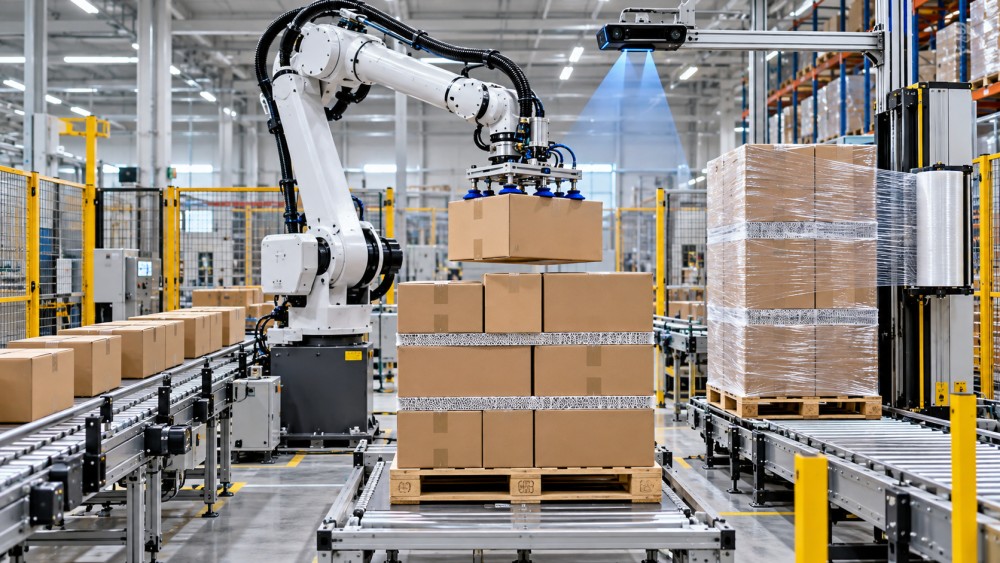
Vision is particularly valuable when production includes frequent SKU changes, variable case sizes, mixed product flows, or packaging that can move on the conveyor. It is less useful when the fundamental issue is internal product movement or insufficient carton strength. A camera may identify a damaged corner; it cannot make that corner load-bearing. In those situations, the better intervention may be upstream packaging control, a revised stacking rule, or segregation of damaged product.
The practical comparison is not “vision versus no vision,” but whether the variability is visible and actionable. If a product’s instability arises from inconsistent external geometry, vision can materially improve handling. If the variation is hidden inside the package, force sensing, weight data, or packaging redesign may be more relevant.
Gripper selection determines whether the pick creates a new defect
The end effector is often the most consequential mechanical choice for unstable products. A palletizer may have accurate motion control, but an unsuitable gripper can crush, drag, twist, or drop the load before it reaches the pallet.
Vacuum grippers are effective for sealed cartons with sufficiently flat, non-porous top surfaces. They can support rapid single-case handling and reduce side contact. Their limitation is that porous corrugated board, dusty surfaces, uneven top panels, or flexible bags may reduce vacuum reliability. Excess suction force can also deform weak packaging.
Clamp or side-grip tools can handle cases that do not provide a reliable vacuum surface. They are useful when controlled lateral support is needed, but the gripping force must be matched to carton compression strength. Excess force can damage corners or cause a bulging case to spring outward after release. For flexible bags, broad-contact clamp surfaces are generally more appropriate than narrow gripping points.
Fork-style or under-support tools support the unit from below and can be useful for deformable packs, trays, and some bundled products. Their trade-off is cycle time and clearance: the tool needs room to enter and withdraw without disturbing adjacent cases. These systems can also be less flexible when layer patterns are tightly packed.
Layer grippers move a full layer at once, often using side clamping, retention plates, or support mechanisms. For stable, standardized cases, layer handling can reduce the number of individual placement events and improve throughput. But it requires a well-formed layer before transfer. If units are not tightly organized on the infeed, a layer gripper can preserve existing disorder rather than correct it.
Adaptive grippers and force-controlled robotic tools address a different problem: they adjust contact force to the actual object instead of applying one fixed setting to every product. That is especially relevant for bags, variable-fill packs, and mixed packaging formats. However, adaptive gripping should not be interpreted as unlimited product flexibility. Every gripper still has limits on weight, surface condition, deformation, and allowable center-of-gravity offset.
Stacking patterns are structural designs, not visual arrangements
A stable pallet depends on how units transfer load vertically and resist movement laterally. A pattern that looks compact may still be weak if vertical seams align through several layers, if heavy cartons sit on weak ones, or if the stack’s center of gravity drifts away from the pallet center.
Automatic palletizers use pattern-generation software to define case orientation, layer rotation, placement sequence, gaps, and the use of sheets or pads. The most useful systems can maintain different patterns by SKU and adjust them when load constraints change. The purpose is not simply to maximize case count. It is to create an arrangement that is compatible with product strength and the anticipated distribution route.
Interlocking patterns rotate or offset cases between layers so that vertical joints do not continue uninterrupted from the pallet deck to the top. They can improve lateral restraint, although the benefit depends on the actual carton geometry and friction. Column stacking, where cases align vertically, can provide more direct compression support for strong, uniform cartons. It may be preferable where box stacking strength matters more than interlock, but it can require additional containment against side movement.
Neither approach is universally superior. A palletizer configured for a highly interlocked pattern can still produce unstable loads if the cartons have large dimensional variation. Likewise, a column pattern can perform well when case strength, pallet dimensions, and downstream wrapping are correctly matched. The appropriate comparison is between the load’s compression needs and its lateral-stability needs.
Placement control prevents impact, drag, and cumulative error
Unstable loads are frequently damaged during placement rather than during picking. A case dropped from a small height can rebound, rotate, or crush the corner of the package below it. A tool that retracts sideways too early can drag a case out of alignment. These small errors accumulate through multiple layers until the top of the pallet visibly leans or overhangs.
Modern robotic palletizers manage this through controlled approach paths, reduced-speed placement near the load surface, and release timing tailored to the end effector. Force sensing can provide confirmation that a case has contacted the layer beneath it before the gripper fully releases. In more advanced applications, feedback can identify abnormal resistance, indicating that the expected placement area is obstructed or the prior layer has shifted.
This is an area where robotic systems generally offer more adaptability than purely mechanical palletizers. A robotic arm can alter its approach angle, pick point, and placement sequence through software. A fixed mechanical system may achieve higher consistency for one stable, high-volume format, but it is less forgiving when packaging or product geometry changes.
Force sensing and weight data serve different purposes
Force sensing is often grouped with vision, but it answers a different question. Vision identifies where an item appears to be. Force sensing indicates what happens when the machine touches it. It can help control gripping pressure, confirm contact during placement, and detect an unexpected collision. This is important for products that deform under load or vary slightly in shape.
Weight data helps manage a pallet’s mass distribution. If connected to checkweighing or product data, the palletizing logic can avoid placing heavier units in locations that worsen lean or overload weaker packaging below. Weight-based rules are especially useful for mixed-SKU pallets, but only if the system can reliably identify each product and enforce the approved stacking sequence.
Neither sensing method eliminates the need for mechanical validation. A load can have correct weight distribution but poor lateral containment. It can also be square and visually aligned while containing cartons that will collapse under compression. Stable palletization requires the sensing strategy to be connected to physical load rules.
Interlayer sheets, slipsheets, and containment complete the load
Some unstable products should not depend on case-to-case friction alone. Interlayer sheets can spread point loads, create a more uniform surface for the next layer, reduce sliding, and protect vulnerable carton tops. Their usefulness depends on material stiffness, friction characteristics, dimensions, and the ability of the palletizer to place them consistently.
Corner protection, top frames, anti-slip materials, straps, and stretch wrap serve different functions. Stretch wrapping provides containment force around the finished pallet; it does not correct a severely leaning stack or restore crushed bottom layers. Strapping can secure certain heavy or rigid loads, but poorly placed straps may damage weak cartons or concentrate pressure on irregular surfaces. A load should be structurally sound before it enters the wrapper or strapping station.
This distinction is important in procurement and line design. A request for “stronger wrapping” may actually indicate a pallet pattern, packaging, or infeed-control problem. Increasing film tension without addressing the cause can deform cases, trap an already unstable shape, or create handling difficulties at the destination.
When automation should reject rather than recover
The most reliable palletizer is not one that attempts to process every defective unit. It is one that recognizes the boundary between recoverable variation and a condition that requires intervention. A slightly skewed carton may be corrected through vision-guided picking. A carton with a collapsed sidewall, an open flap, or dimensions beyond the approved envelope should normally be diverted for inspection or rework.
Clear reject criteria protect both throughput and safety. They also prevent a common operational error: treating repeated robotic faults as a robot problem when the true cause is inconsistent upstream packaging. Rejected-unit data can reveal whether instability is linked to a particular production batch, carton supplier, filling process, conveyor transfer point, or SKU configuration.
Choosing the right approach depends on the nature of variability
For stable, uniform cartons, a conventional palletizer with disciplined infeed control and validated patterns may be sufficient. For operations with variable orientations, frequent format changes, or cartons that shift during transport, vision-guided robotics provide a stronger ability to correct placement in real time. For bags, pouches, and other deformable packaging, the priority shifts toward end-effector design, force control, and a stacking pattern that manages compression and lateral spread.
The central question is not whether an automatic palletizer can handle unstable loads. It can, within defined limits. The more useful question is where the instability originates and which control layer addresses it: product qualification, infeed conditioning, machine vision, gripper behavior, stacking logic, or final containment. Systems perform reliably when those layers are designed as one load-stability process rather than as separate pieces of equipment.
Related News
- How Do Automatic Palletizers Handle Unstable Loads?Oct 04, 2026How do automatic palletizers handle unstable loads? Discover how vision, adaptive grippers, smart stacking, and containment improve pallet stability.
- Robotic Palletizers Factory Guide: Cut Labor Without BottlenecksJul 07, 2026Robotic palletizers factory guide: learn how to cut labor, prevent end-of-line bottlenecks, and choose systems that improve throughput, load stability, and ROI.
- How to Compare End-of-Line Palletizing Suppliers for Throughput and FootprintJul 05, 2026End-of-line palletizing supplier comparison starts with real throughput and total footprint. Learn how to evaluate uptime, integration, and support to choose a smarter, scalable solution.
Related News
- 00
0000-00
Which design features make warehouse cross-belt sorters low-maintenance? - 00
0000-00
When should you choose a shoe sorter over a cross-belt sorter? - 00
0000-00
Preventing bottlenecks in conveyor-fed robotic end-of-line packaging - 00
0000-00
What CE documentation should an end-of-line automation exporter provide? - 00
0000-00
What throughput should a high-speed sorting systems factory guarantee?
Palletizing Dynamics Expert
Weekly Insights
Stay ahead with our curated technology reports delivered every Monday.